
The Safety Plan tab
The Stanley-Brown safety plan in Pippa: its six sections, how it is shared with the care team, and how the patient sees it read-only in their app.
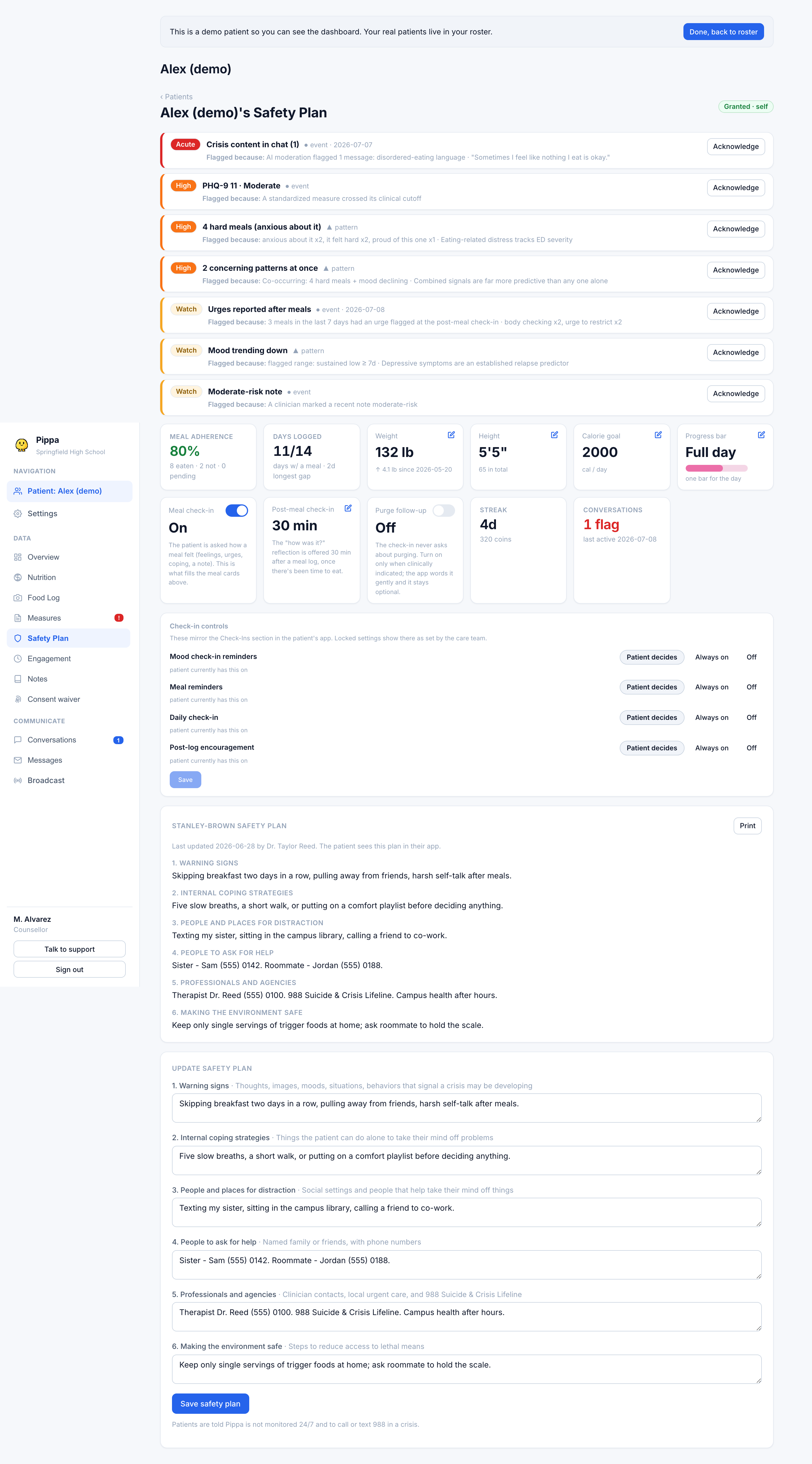
The Safety Plan tab holds one Stanley-Brown Safety Planning Intervention per patient. It is a structured, collaborative crisis plan, not a free-text clinical note. It is shared with the care team and shown to the patient in their own app, so it is there when they need it most.
The six sections
The plan follows the Stanley-Brown model. You fill in each section in the editor at the bottom of the tab.
Thoughts, images, moods, situations, and behaviors that signal a crisis may be developing.
Things the patient can do alone to take their mind off problems.
Social settings and people that help take their mind off things.
Named family or friends, with phone numbers.
Clinician contacts, local urgent care, and the 988 Suicide and Crisis Lifeline.
Steps to reduce access to lethal means.
Only the sections you fill in are shown; blank sections are hidden from the patient's view. Press Save safety plan to store it and push it to the patient's app. The header records who last updated it and when, and a Print button produces a paper copy for the chart or for the patient to take home.
It is care-team shared, not a private note
The safety plan is deliberately not a private clinical note. Unlike the Clinical Notes tab, which is clinician-only, the safety plan is shared with the care team for this patient and is visible to the patient. It is a single shared record: if a colleague with consent updates it, everyone sees the current version.
Whatever you save appears in the patient's app so they can reach it in a moment of crisis. The patient can read it but cannot edit it; only the care team changes the plan. Write it in warm, direct, second-person language they can actually use.
Pippa is not a monitored crisis line
Patients are told plainly that Pippa is not monitored 24/7, and that in a crisis they should call or text 988 (the Suicide and Crisis Lifeline). For eating-disorder support the app routes patients to ANAD at 888-375-7767. The safety plan complements those resources; it does not replace them. When you record a positive C-SSRS on the Measures tab, review and, if needed, update the safety plan at the same time, and follow the crisis playbook.