
ARFID mode
A per-patient care approach for Avoidant/Restrictive Food Intake Disorder that quietly celebrates every new-food try, counts tries per food, and swaps the urge chips for a steps-to-eating ladder, while your dashboard gains a positive New foods card.
ARFID, Avoidant/Restrictive Food Intake Disorder, is not about weight or shape. These patients want to eat a wider range of foods and can't, whether the barrier is sensory sensitivity, a fear of choking or vomiting, or simply low interest and appetite. That makes most of the app's ED-safe scaffolding, which is tuned for anorexia and bulimia, the wrong fit: urge chips, body-image framing, and "listen to your fullness" language all miss. ARFID mode retunes the patient's app for the work you are actually doing, which is CBT-AR style graded exposure, one small try at a time.
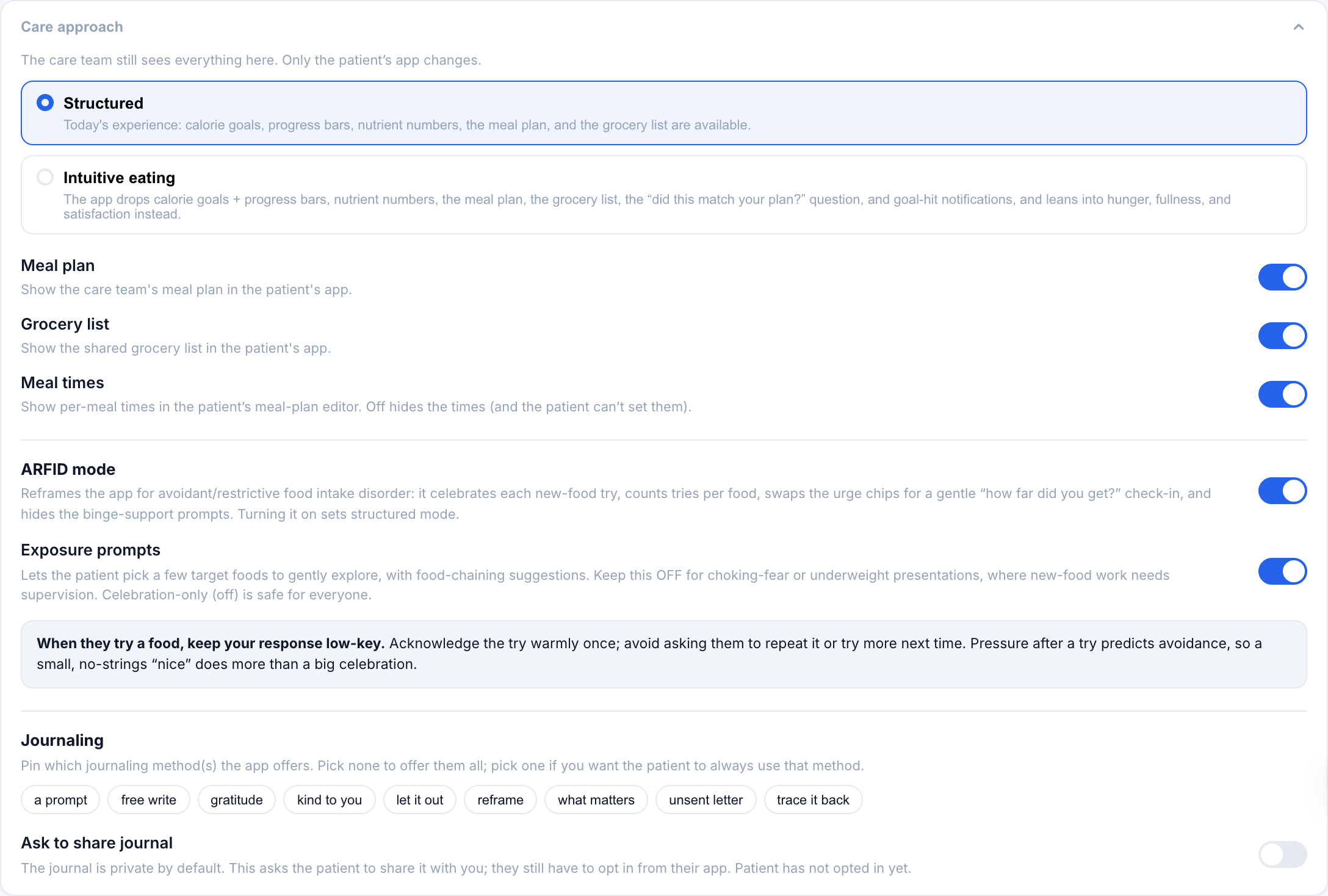
You turn it on from the Care approach card, the same card that holds the structured and intuitive eating choices. It is off by default. Every patient starts in Structured, and nothing changes until you deliberately switch a patient over.
Turning it on
ARFID mode is a per-patient switch you control. Enabling it does two things at once:
| When you enable ARFID mode | What happens |
|---|---|
| The mode itself | The patient's app shifts to celebrate new-food tries, count tries per food, and swap the check-in chips. See below for the full list. |
| Structured framing | ARFID mode also sets the patient to Structured, because CBT-AR begins with regular eating on safe foods. It is mutually exclusive with intuitive eating, which relies on appetite cues that low-appetite ARFID cannot lean on. |
Below the mode is Exposure prompts, which turns on target-food picking and food-chain suggestions. Leave it off for choking-fear or underweight presentations: those need supervised exposure, never an app nudge, and underweight patients need volume before variety. The celebration and counting half of ARFID mode only reacts to what the patient already ate, so it is safe for everyone. The prompting half is the piece you gate.
What the patient's app does in ARFID mode
Everything below reacts to a meal the patient already logged. None of it asks them to eat more.
- It celebrates each new-food try, quietly. The first time a food shows up for a patient, the app offers a small, warm note. The tone is deliberately low-key, never confetti and never trait praise, because pressure after a try is the one thing the evidence says backfires (Batsell, Galloway). A try is a complete event that implies nothing about tomorrow.
- It counts tries per food. Liking a new food usually takes ten to fifteen low-pressure tastes (Birch & Marlin; Cooke's Tiny Tastes), so the app tracks a gentle try count per food and offers soft encouragement on repeat visits, never a countdown or a target.
- A smell or a lick counts as a try. Following the SOS steps-to-eating hierarchy, partial contact is a real try. Swallowing is not required for the counter to move.
- It swaps the urge chips for a steps ladder. The restrict/purge/binge/body-check chips are AN/BN framing that does not fit ARFID, so on new or target foods the check-in asks how far the patient got instead.
- It disables the binge-support surfaces. Episode detection, the overeating sheet, and the risk-window nudge are turned off, since their heuristics misfire on low-appetite grazing.
The check-in the patient sees
On a new or target food, the post-meal check-in trades the urge chips for a steps-to-eating ladder, where every rung is celebrated equally, plus a gentle feeling chip where not for me yet is a completely valid, warmly received answer.
Safe foods are never framed as a problem in any of this. In CBT-AR they are the foundation you build regularity on, and the app treats them that way.
The New foods card on your dashboard
In ARFID mode, the patient's overview gains a positive New foods card. It is the medical half of the picture: dietary variety is clinically actionable in ARFID, where deficiency disease appears even at a normal weight, so seeing what a patient is trying is genuinely useful.
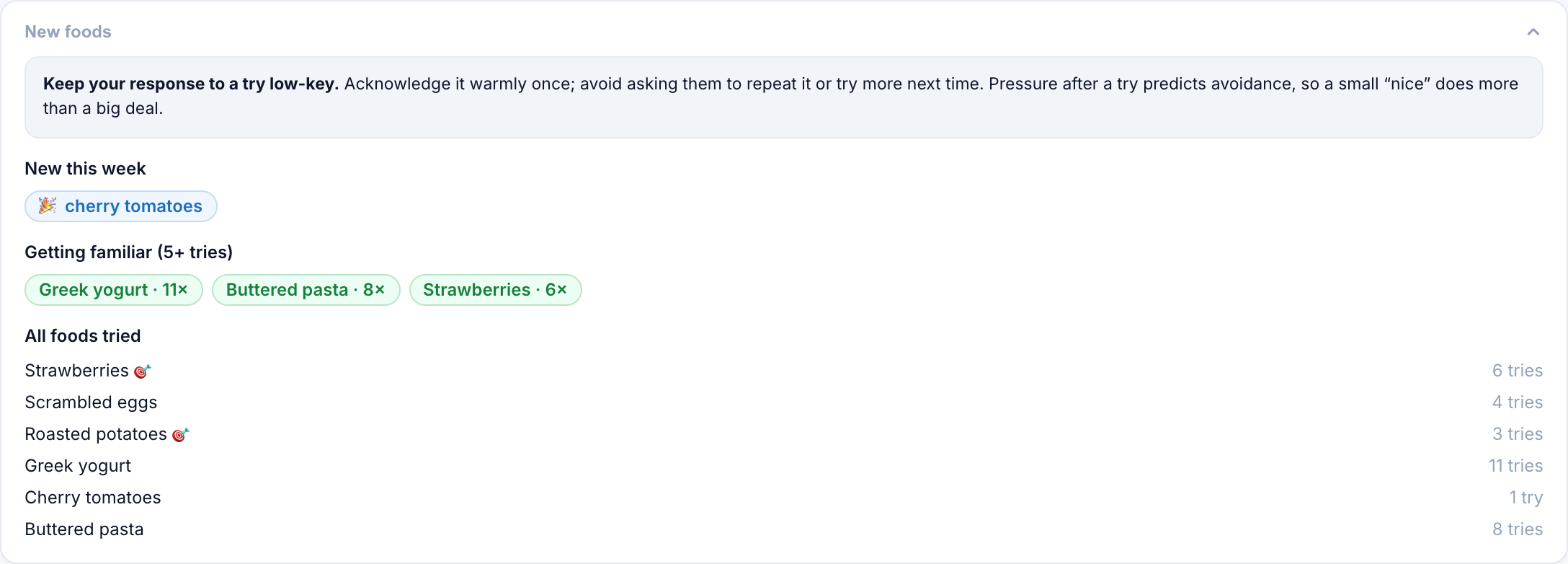
The card shows:
| On the card | What it tells you |
|---|---|
| Variety this week | New foods tried this week, so you see momentum rather than isolated events. |
| Per-food try counts | Each food and how many times the patient has tried it, with target foods highlighted. |
| Foods at 5+ tries | The foods approaching the ten-to-fifteen-try range where liking tends to develop. |
| Total distinct foods | The overall breadth of what the patient is eating. |
The card ships with an inline tip: keep your response low-key, acknowledge a try warmly once, and avoid asking them to repeat it or try more next time, because pressure after a try predicts avoidance. This is the highest-leverage safety feature in ARFID mode. There is deliberately no one-tap "encourage them to try again" action anywhere on the card.
New-food tries also appear as arfid.try entries in your care-team activity feed,
worded as a note (Tried a new food: cherry tomatoes or Try #5: peppers). These are
never risk alerts and never send a push. A new food is not an emergency; it is something you see next
time you open the page.
ED-safety rails
- Default off. Nothing changes for a patient whose care team never opens the Care approach card.
- Clinician-controlled. Only the care team turns on ARFID mode, and only the care team turns on Exposure prompts.
- The celebration is small on purpose. No confetti, no trait praise, no amount or finishing words, no "again tomorrow," no per-food streaks. Quiet delight is the design, not a limitation.
- Safe foods are never a problem. They are the foundation regularity is built on, and neither the app nor the dashboard frames them otherwise. No hidden-ingredient tips are ever offered.
- Silence about non-tries is absolute. The absence of a new food is never nudged and never styled as a risk.
- Exposure prompting stays off for supervised presentations. Choking-fear and underweight patients get celebration and counting only, never app-initiated exposure. The patient picks their own target foods; they are never assigned.
The food chart
Patients in ARFID mode can sort their ledger into eating now / working on / not yet — the feeding-therapy traffic light, kept patient-owned and free of any nutritional input. You see their sorting read-only inside the New foods card. See The food chart.