
Pippa chat
The AI companion chat: the first-time disclosure, the crisis safety tiers, meal-time support, the tappable coping-skill chips, and what escalates to you.
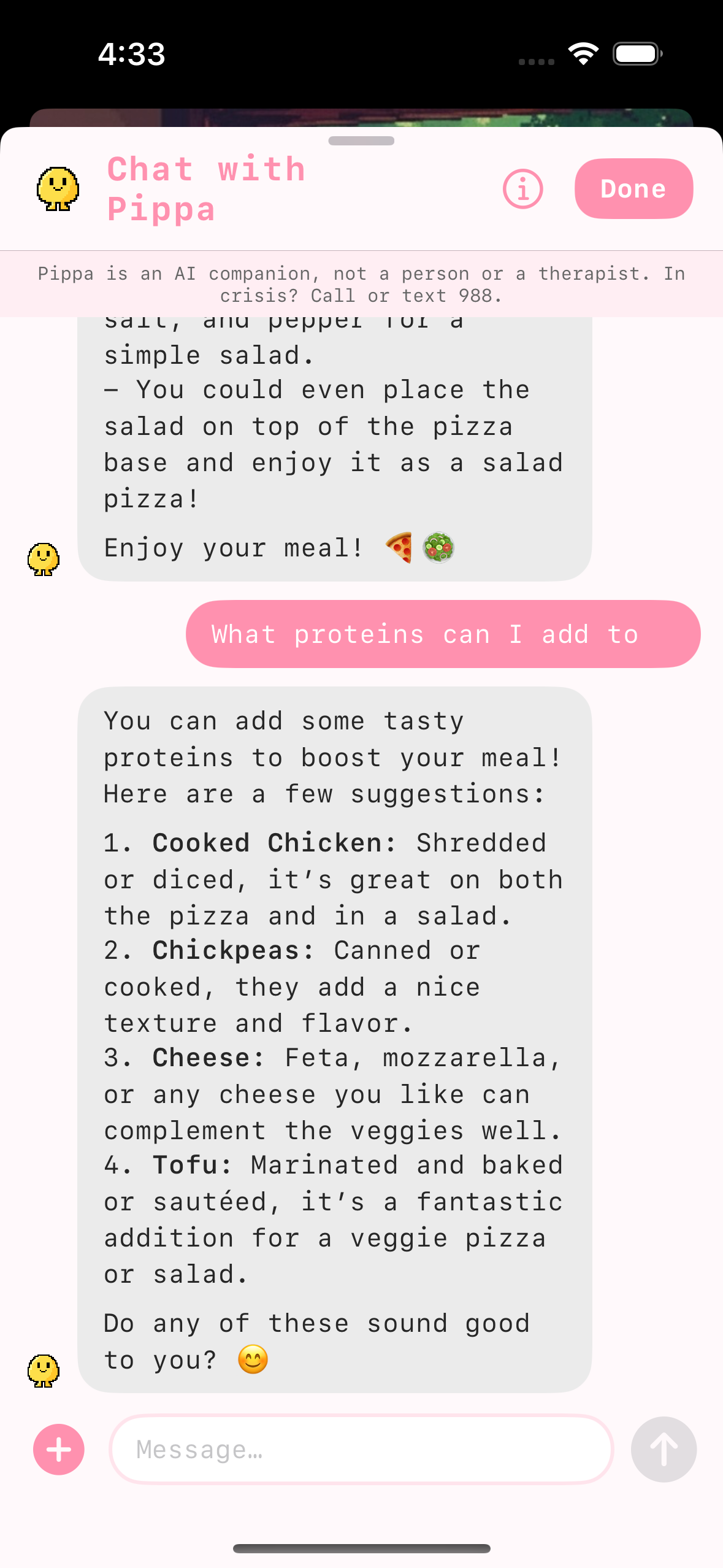
Pippa includes an AI chat companion. It is warm and open-ended, focused on food, feelings, and support, and it is built with heavy guardrails because vulnerable clients tend to trust a chatbot uncritically.
The first-time disclosure
Before the very first chat, a modal makes clear that Pippa is not a person: quick note before we start, followed by Not a therapist, a doctor, or a crisis line. and Can get things wrong, so please don't treat replies as medical advice. The opening disclosure also asks one quick thing, are you in New York?, since New York asks us to remind those clients a little more often that Pippa is an AI. A persistent banner then stays at the top of every session: Pippa is an AI companion, not a person or a therapist. In crisis? Call or text 988. The disclosure re-shows after a 7-day gap.
The periodic AI reminder
For minors, and now for any client who told us they are in New York, Pippa also drops a periodic "I'm an AI, not a person" reminder about every 3 hours while the chat stays open: a warm line noting Pippa is an AI companion, not a real person, and that a break might be nice. It is required by New York's AI-companion law, so it now covers New York clients of any age, not just minors. The reminder is shown on screen only; it is never saved to memory or sent to the model.
Getting a conversation started
On an empty chat, under the line Not sure where to start? Tap one:, six starter chips give safe openings: Help me get through a tough meal, I'm feeling anxious right now, Talk me through an urge, Celebrate a small win with me, I need a distraction, and Help me be kind to myself today. They only appear while the thread is fresh, so returning clients are not re-prompted.
What the bot will and won't do
Pippa is instructed to never state calories, portions, weights, or any food or body number. It also declines to feed reassurance loops (repeated "was that too much?" checking), and it always sides with recovery, warmly, never helping a client eat less. On top of the model's own rules, an on-device screen catches pro-ED phrasing before it is ever shown, and that turn is flagged to you.
The safety tiers
Crisis language is caught locally, before any text leaves the device, so an outage or jailbreak cannot bypass it. There are four tiers, checked in order.
- Self-harm routes to 988, Suicide & Crisis Lifeline (call or text, 24/7) and Text HOME to 741741.
- Violence routes to 911 and 988.
- Medical ED (chest pain, fainting, can't keep food down, throwing up blood) is treated as a medical emergency: Call 911 or go to an ER, call your care team today, and 988 anytime.
- Eating disorder (acute purge, restriction, or relapse language) routes to ANAD Eating Disorders Helpline, (888) 375-7767, plus 741741 and 988, and gently encourages telling the care team.
The NEDA helpline closed in 2023, so Pippa routes eating-disorder support to the ANAD peer line at 888-375-7767.
Tappable coping-skill chips
When a client seems triggered, stressed, or is fighting an urge, Pippa empathizes in words and then offers one built-in coping tool as a tap-through chip under its reply, for example 🫧 breathe with me ›, 🌊 ride the wave together ›, 🌿 ground me ›, or 💛 be kind to me ›. One tap opens that tool directly, no menu detour. If the model forgets to offer one but the client's own message reads as distress, Pippa attaches the best-fit chip anyway. On an eating-disorder crisis, a "ride the wave" chip is offered after the resources, but self-harm, violence, and medical crises stay hotline-only so a breathing exercise never dilutes a 988 moment.
Meal-time support
When a client turns to the chat mid-meal ("Help me get through a tough meal", or any message that reads as active eating distress), the bot switches into a meal-support mode built from published meal-support protocols (FBT, Renfrew, Beat, NHS guidance). Two rules define it:
- The off-food rule. While the client is distressed at the table, the bot keeps the entire conversation away from the food itself: no recipes, no food memories, no describing or praising the plate, no "how does it taste." Attention on the food feeds the fear, so the bot points attention elsewhere and keeps them company.
- Skills matched to arousal. If the client is panicky, the bot offers only presence and body grounding (feet on the floor, one long exhale), nothing cognitive. If they are distressed but talking, it offers slow breathing, holding something cool, or gently naming the thought. Only once they are calmer does it connect the moment to what they care about.
Declines are respected the first time: the bot never re-pitches a refused skill, and after two declines it stops offering tools entirely and just keeps warm, non-food company. When the meal ends, however it ends, the bot stays for the hour after, the hardest window, and never reviews or evaluates what was eaten.
What escalates to you
Every chat turn is saved so you can review it (with consent) and so it survives across devices. Two things are specifically flagged for your attention: a crisis category caught on the device (even an ED-specific one a generic moderator might miss), and any bot reply that had to be swapped out for drifting into pro-ED phrasing. Privacy-safe monthly crisis counters are kept with no personal content attached.